NewsCausal intelligence cut one manufacturer’s defects by 50%Read the story

AI visual inspection and production intelligence for technical webbings

Catch webbing defects like weave flaws, broken or pulled picks, knots, frays, and weft skips in real time on your line. Turn what you learn into less waste and smarter production.

What if a bad roll never left your factory again, and you had an inch-by-inch photo history of every roll to prove it?

CATCHING DEFECTS EARLY MATTERS

The cost of a single missed defect quickly compounds.

What one escape costs
A pulled pick you catch late costs more than the roll.
Wasted webbing
Hundreds of yards run before the roll is pulled
$180
Line downtime
Stopped to rethread and re-web
$400
A downgraded roll
Sold as seconds, or scrapped outright
$900
A rejected shipment
The converter downstream catches it first
$5,000+
WHAT A MISSED STREAK BECAME
$6,420+ & a hold
The converter who got the bad roll now inspects every shipment you send, or quietly moves the program to a supplier they don’t have to double-check.
One escaped web defect, start to finish: your line’s numbers may differ.

Technical webbing lines just got smarter.

The webbing defects we can catch

  • Weave flaws
  • Broken & pulled picks
  • Knots & frays
  • Weft skips
  • Coating flaws & edge damage

The specs

Line speed
1000+ft/min
≈ 305+ m/min
Web width
10+in
webbing, edge to edge
Smallest defect
0.1mm
sub-millimeter
Inspection
100%
every inch of every roll

We can predict defects before they happen.

Your web defect rate, connected to your facility’s environmental data.

Avg Daily Humidity vs Defect Rate
Humidity (%)Defect rate (%)
304050607080Humidity (%)0246810Defect rate (%)3 Jun4 Jun5 Jun6 Jun7 Jun8 Jun9 Jun10 Jun
Move your cursor across the chart to watch the defect rate follow the 8 Jun humidity spike.
How It Works

We manage the system that lets your line learn.

Designed to handle the most nuanced weaving defects that others call impossible.

01

Camera

The eyes

A vision setup that's flexible, allowing us to tailor to the specifics of your web, your substrate, and your line speed.

02

Hardware

The edge

State-of-the-art NVIDIA compute, on-prem in a rugged box wired straight to your line and the vision system.

03

Software

The platform

A browser-based live dashboard that allows you to view any line from anywhere, generate audit-ready report cards, and visualize predictive data.

04

Machine learning

The intelligence

A menu of large, custom-built models that allow us to find defects without a reference image across hundreds of SKUs.

We don’t sell you a camera and wish you luck. We manage the technology, so you get a smarter line, not more work.

What Shelfmark delivers on a webbing line

up to
ROI
inside year one
up to
90%
waste reduction
vs. manual review
 
1/2
inspection labor needed
on the line
 
99.5%
inspection accuracy
on any SKU

Here’s what we can do for you. That nobody else can. Shelfmark compared with traditional machine vision systems, on seven specs for technical webbing.

Shelfmark
Traditional machine vision systems
Only ShelfmarkThe line learns after every run.
Everyone elseNo retained context, so the same defect happens again.
Only ShelfmarkWe retrain the model. No recipe, no invoice, no wait.
Everyone elseWrite a recipe. Pay for a change order. Wait.
Only ShelfmarkA defect map of the whole roll, so you know exactly where to cut for downstream value-add.
Everyone elseA flag, and a line stop.
Only ShelfmarkWe run it. Monitoring, tuning and drift are our job.
Everyone elseYou own the tuning, the false alarms, the upkeep.
Only ShelfmarkA managed service. Operating expense, scoped to your lines.
Everyone elseA large capital purchase, paid up front.
Only ShelfmarkDeep-learning models trained on your real defects.
Everyone elseFixed rules and thresholds you configure by hand.
Only ShelfmarkDetect, predict, prevent, on one source of truth.
Everyone elseDetection, and a screen full of flags.

Webbing makers you know already run it.
Large U.S. parachute manufacturer
Private · defense & aerospace · webbing inspection
6 minutes
A football field of webbing, inspected end to end.
Every roll used to be unrolled by hand, foot by foot. Now each defect is found and physically tagged before the webbing reaches a sewing table.
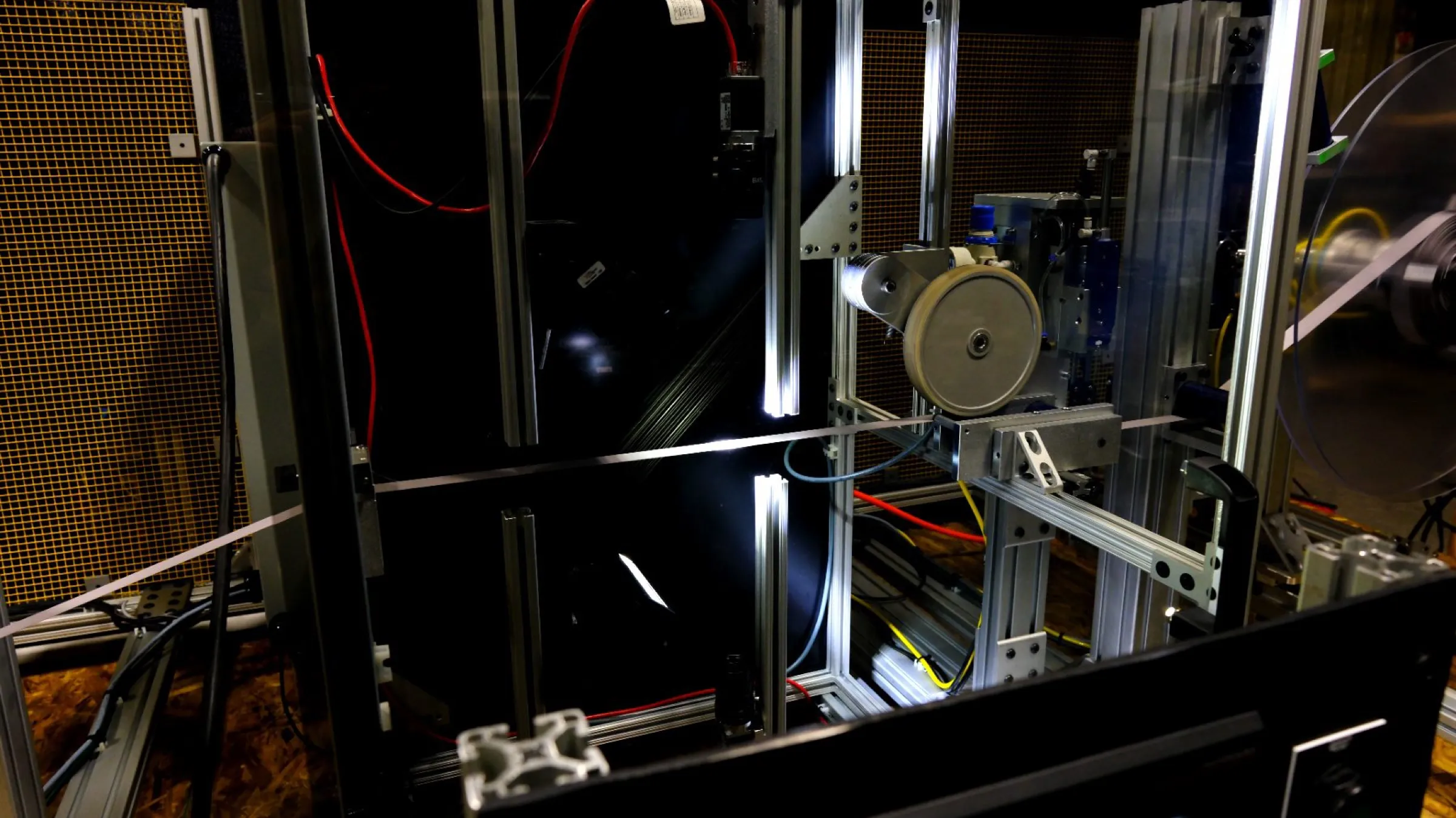
On the lineInside a Shelfmark inspection frame on a webbing line: a strip of webbing running horizontally between backlit inspection bars, with the cameras aimed at it through the guard glass.
In the platform

The questions webbing manufacturers actually ask.

Do we have to write a recipe every time an SKU or defect changes?

No, and that is the core difference. When a new SKU or a new defect appears, retraining the model is our job, not a change order you write and pay for. You are never locked into editing recipes to keep inspection working.

Do you tell us where the defects are on the roll?

Yes. You get a defect map of the whole roll, every flaw located by position, so you know exactly where to cut around it for slitting, laminating, or other downstream value-add, instead of scrapping good web with bad.

Can Shelfmark run alongside or replace our current web inspection?

Either. We can augment a system you already run or replace it. Because we mount our own cameras and run our own models, we are not dependent on your current vendor’s software or recipes.

Is this a capital purchase or a service?

A service. Instead of a large machine-vision system bought up front, you pay as an operating expense scoped to your lines, and tuning and upkeep are included, not billed per change.

What about false alarms and nuisance defects?

Deep-learning models are tuned to your real defects, not fixed thresholds, so the system learns the difference between a defect that matters and harmless web variation, and we keep tuning it as your product mix changes.

Will it keep up with our line speed and web width?

Yes, and on webbing inspection is rarely the constraint. A needle loom weaves a few feet of webbing a minute, and our off-line pass reads a football-field-long roll in about six minutes across the full width. Inspection never becomes the bottleneck.

Do we own our inspection data?

Yes. Every roll stays on the record and is yours, queryable across lines and plants, exportable any time. The platform is the single source of truth for your quality data, not a black box.

What defects can Shelfmark catch on a roll of technical webbing?

Weave defects, broken and pulled picks, knots and frays, weft skips, plus coating flaws, contamination and edge damage. Down to roughly 0.1 mm, across the full width, every inch of the roll inspected.

What happens the moment a defect is found?

The floor is alerted immediately: an alarm at the line and the defect image on screen, tagged to the exact position on the roll. Your operator decides what to do; nothing ships with a defect nobody saw.

How long does install take, and does the line stop?

A single line is typically instrumented and inspecting within days, not months. We mount cameras over the web, calibrate to your speed and width, and tune against your real defects. No teardown, and you never write a rule.

Talk to a
Shelfmark expert.

See if it’s a fit.
In 30 minutes you’ll know whether we can catch your defects, on your substrate, and your line speed.
See what’s possible.
We can show you the real thing. A line with every defect caught automatically; fewer escapes, less rework, and capacity you didn’t know you had.
See if we are full of shit.
We are a young company doing things that have never been done before. We own that, and we will answer any questions you have.